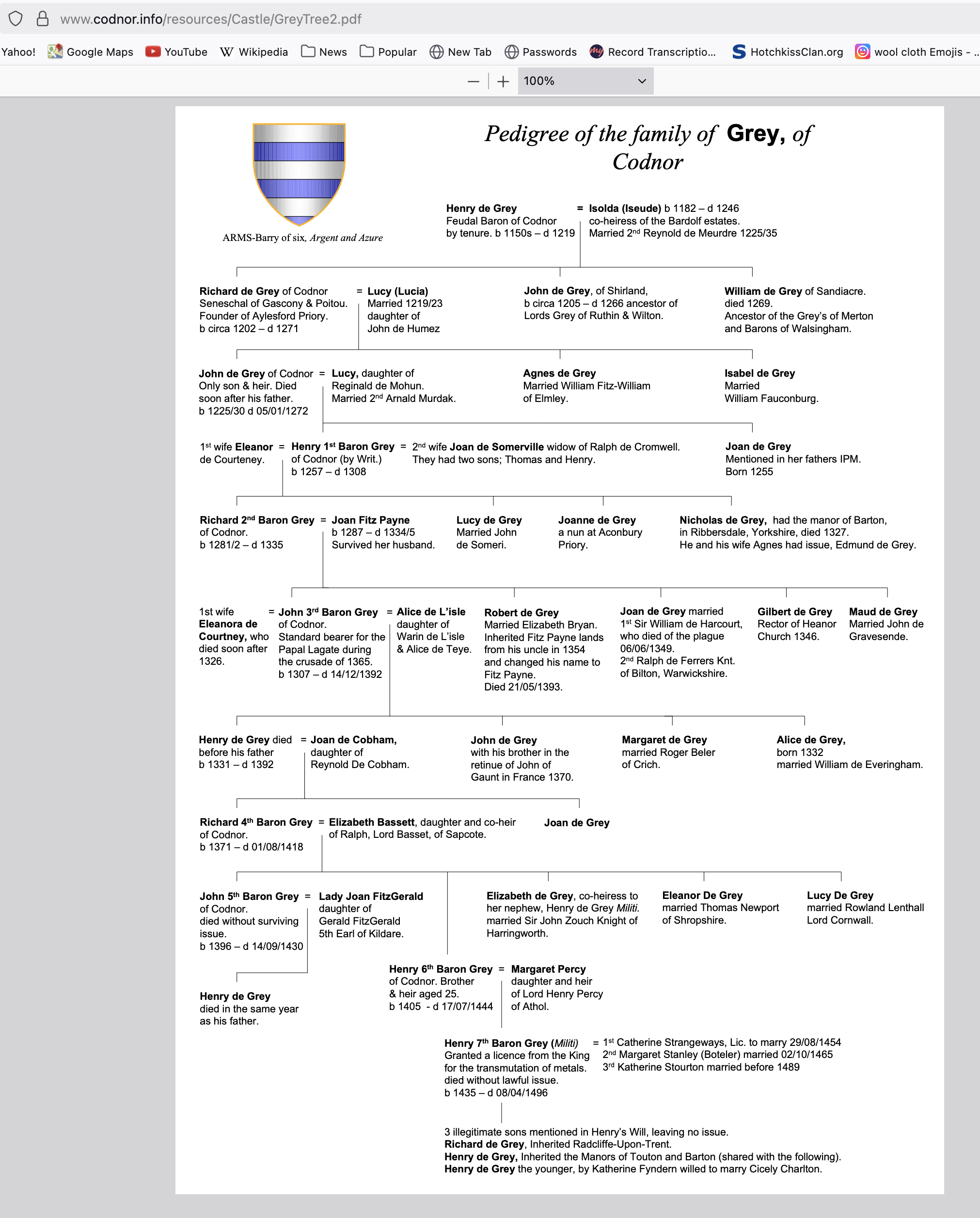
deGreyChart
John was born about 1320, the son of Richard de Grey and Elizabeth FitzPaen. The place is not known.
He died on 14 DEC 1392. The place is not known.
His wife was Eleanora de Courtney. They were married, but the date and place have not been found. Their only known child was Henry (c1341-1392).
| + | ||||||||
| | ||||||||
| | ||||||||
| + | ||||||||
| | ||||||||
| |
| Event | Date | Details | Source | Multimedia | Notes |
|---|---|---|---|---|---|
| Birth | ABT 1320 | ||||
| Death | 14 DEC 1392 |
deGreyChart |
Note 1
!Source: Richard Grey, 2nd Baron Grey of Codnor https://en.wikipedia.org/wiki/Richard_Grey,_2nd_Baron_Grey_of_Codnor
Richard Grey, 2nd Baron Grey of Codnor , of Codnor Castle, was an English soldier and diplomat.
Life
Grey was the eldest son of Henry Gray, 1st Baron Grey of Codnor and Eleanor de Courteney. Richard succeeded to his father's titles in 1308, upon Henry's death. Richard was one of the barons who at the assembly of Stamford on 6 August 1309, signed a letter of remonstrance to the pope on the abuses in the church. He was employed in the Scottish wars in 1311, fought during the English defeat of the Battle of Bannockburn in 1314,[1] and again in 1319–20 during the unsuccessful siege of Berwick and other confrontations against the Scots in the Scottish Marches. During the baronial revolt against King Edward II of England, known as the Despenser War, he assisted Roger Mortimer and the Marcher Lords, who attacked and plundered the Welsh possessions of royal favourite Hugh le Despenser, the younger. For these attacks, Richard was pardoned by Parliament in August 1321.[2] Together with John Giffard and Robert de Shirland, they testified to the claim of Bartholomew Badlesmere that Despenser, the younger was a traitor.[3] Misled by false letters, the rebels attempted to place Gray, Giffard and Shirland firmly on their side,[4] but from the end of 1321 Gray was firmly on the side of Edward II, who took action against the baronial opposition. Richard served with the royal army, which pursued the rebels under the command of Thomas of Lancaster to the north of England. Grey remained in the favour of the king, who visited him after the victory over Lancaster in March 1322 at Grey's castle at Codnor, Derbyshire.
In 1324 Gray was appointed to the office of Seneschal of Gascony and Steward of the Duchy of Aquitaine.[5] Gray resigned this office, in October 1324, serving Edmund of Woodstock, Earl of Kent during the war in Gascony. He was then sent to defend Argentan, in the Duchy of Normandy. In 1326, Richard was Constable of Nottingham Castle and in 1327 he was employed in the Scotch marches, and was summoned for the Scottish war in 1334, but was excused on the ground of sickness. He died in 1335.
Marriage and issue
Richard married Joan, daughter of Robert FitzPayne, Lord FitzPayne and Isbella de Clifford. <<<< This follows Cokayns mistaken linage here, as wife & mother is Elizabeth, daughter of their son Robert II. Joan didn’t exist.
Jane Grey, married firstly William de Harcourt and secondly Ralph de Ferrers.
John Grey , married firstly Alianora and secondly Alice de L’isle, had issue.
Robert Grey , married Elizabeth Bryan, had issue. <<<< Also missing younger brother Gilbert mentioned in numerous fines shown here.
His son Robert, took his mother's maiden name and became known as Robert FitzPayne.
Citations
Morris 1914, p. 35.
Mortimer 2003, p. 110.
Phillips 2010, p. 389.
Fryde 2003, p. 46.
Burke 1831, p. 234.
References
Burke, John . A general and heraldic dictionary of the peerages of England, Ireland, and Scotland, extinct, dormant, and in abeyance. London: Henry Colburn and Richard Bentley.
Fryde, Natalie . The tyranny and fall of Edward II, 1321–1326. Cambridge: Cambridge University Press. ISBN 0-521-54806-3.
Morris, John E. . Bannockburn. Cambridge: Cambridge University Press.
Mortimer, Ian . The Greatest Traitor. The Life of Sir Roger Mortimer, 1st Earl of March, Ruler of England, 1327-1330. London: Jonathan Cape. ISBN 0-224-06249-2.
Phillips, Seymour . Edward II. New Haven: Yale University Press. ISBN 978-0-300-15657-7.
!Source: Codnor Castle's history https://www.codnorcastlehistory.com/history.html
Henry De Grey took an active part in the Scottish wars of King Edward I and served in Prince Edwards force and later in the Earl of Pembroke’s force. In 1293 King Edward I visited Codnor Castle. The following year Henry was preparing to go to Gascony with Edmund, the king’s brother and made arrangements should he die in service while his son was a minor. He was in Gascony again in 1297. In 1300 Henry was to ensure that those in Essex and Hertford required for military service should attend the king at Carlisle for action against the Scots. Henry was at the siege of Caerlaverock castle and is among those listed at Berwick, 1306, whose wages were to be paid. Henry was given rewards from the king including custody of Burgham during the minority of the heir, and a pardon for £200 debts to the Exchequer in 1305. In the following year Henry was given a pardon for all debts, whether from himself or his ancestors, in consideration of his service in Scotland.
Henry died in 1308 and his son Richard inherited Codnor Castle.
Richard De Grey served in the Scottish wars of Edward II’s reign and in March 1322 King Edward II visited Codnor Castle. Richard De Grey held the office of Constable of Nottingham castle from 1325-1328. During the seventh year of King Edward III’s reign , Richard was summoned to Newcastle to march with Edward against the Scots. However due to old age Richard’s eldest son John went in his place. Richard De Grey died while John was fighting in the north and so John De Grey became the new lord of Codnor castle.
John De Grey spent his life in the service of his king. Most notably he served in Flanders in 1330 and 1338, then in 1339 he is said to have played his part in commanding a naval fight at Sluys.
When the Scots invaded England, John was commanded to gather all the men in Derbyshire between the ages of 16 to 60 years. At the battle of Neville’s Cross it was mainly due to the strength of this retinue that England won the battle. John De Grey was involved in the Crecy expedition and he was with the king during the siege of Calais. John also took part in the battle of Crecy in 1346, where the English Army were heavily out numbered. The battle of Crecy was won by the English due to using their highly skilled archers, knights and men at arms on foot to devastating affect.
During 1356 to 1359 John served in the wars in France, which in time would be known as the 100 years war. John De grey for his services in the wars against the Scots and the wars in France was appointed Governor of Rochester town and castle for life. John was said to be so great in tournaments that his prowess led to royal gifts of accoutrements of Indian silk and a hood of white cloth embroidered with blue men dancing, buttoned with great pearls.
In 1371 John was given exemption for life from all offices and coming to parliament, this was because of his long service in war at home and in France. John continued to carryout much of his work and he was summoned to parliament again in 1372 and he continued to do so until his death in 1392. John de Grey’s grandson Richard became heir to Codnor castle as his son Henry had died before him.
!Source: Baron Grey of Codnor https://en.wikipedia.org/wiki/Baron_Grey_of_Codnor
Medieval Barons Grey of Codnor
The following have been historically referred to as holders of this Grey title.[8] During the 1989 abeyance termination proceedings it was deemed that they were summoned to Parliament, but there was no evidence that they sat in a properly constituted Parliament.[9] Having said that there is no reason why a title need be created by a writ of summons, it could also be issued by writ of patent directly from the Sovereign without any necessity for approval of a parliamentary assembly, which at any event were not in a fixed place in 13th and 14th centuries.
Henry Grey, 1st Baron Grey of Codnor
Richard Grey, 2nd Baron Grey of Codnor
John Grey, 3rd Baron Grey of Codnor . <<<< John was born a bit later, 1320, since his mother was too young for these dates.
!Source: Pedigree of the family of Grey, of Codnor https://www.codnor.info/resources/Castle/GreyTree2.pdf
Henry de Grey = Isolda b 1182 – d 1246
Feudal Baron of Codnor co-heiress of the Bardolf estates.
by tenure. b 1150s – d 1219 Married 2nd Reynold de Meurdre 1225/35
-
Richard de Grey of Codnor = Lucy
Seneschal of Gascony & Poitou. Married 1219/23
Founder of Aylesford Priory. daughter of
b circa 1202 – d 1271 John de Humez
-
John de Grey of Codnor = Lucy, daughter of
Only son & heir. Died Reginald de Mohun.
soon after his father. Married 2nd Arnald Murdak.
b 1225/30 d 05/01/1272
-
Henry 1st Baron Grey = 1st wife Eleanor
of Codnor de Courteney.
b 1257 – d 1308
-
Richard 2nd Baron Grey = Joan Fitz Payne <<<< False, corrected entry is Elizabeth Fitz Payne born about 1306. If husband died 1335, then she lived longer than 1334/5.
of Codnor. b 1287 – d 1334/5
b 1281/2 – d 1335 Survived her husband.
-
John 3rd Baron Grey = 1st wife <<<< Wife died soon before the birth of her children, bnut since they were later than stated, the death was a bit later too.
of Codnor. Eleanora de
Standard bearer for the Courtney, who
Papal Lagate during died soon after
the crusade of 1365. 1326
b 1307 – d 14/12/1392 <<<< False, birth at least 1320, likely later.
-
Henry de Grey died = Joan de Cobham, <<<< birth has to be later, say 1341, as was obviously based on father’s birth, and supposed birth of Joan FitzPayn.
before his father daughter of
b 1331 – d 1392 Reynold De Cobham.
-
Richard 4th Baron Grey = Elizabeth Bassett, daughter and co-heir
of Codnor. of Ralph, Lord Basset, of Sapcote.
b 1371 – d 01/08/1418
-
John 5th Baron Grey = Lady Joan FitzGerald <<<< See John’s brother, Henry 6th Baron Grey, b 1405 - d 17/07/1444
of Codnor. daughter of
died without surviving Gerald FitzGerald
issue. 5th Earl of Kildare
b 1396 – d 14/09/1430
-
Henry de Grey
died in the same year
as his father.