VisOfKentHaw...
VisOfKentHaw...
Thomas was born about 1537, the son of Thomas Hawkins and Ellianor At-see. The place is not known.
He died in 1617. The place is not known.
His wife was Anne Petit, who he married in 1574. The place has not been found. Their eight known children were Thomas (c1575-c1640), Suzan (c1577-?), Henry (c1579-?), Richard (c1583-?), Anne (c1585-?), John (c1587-?), Benedicta (c1588-1661) and Ciriack (c1589-?).
| + | ||||||||
| | ||||||||
| | ||||||||
| | ||||||||
| | ||||||||
| | ||||||||
| | | |||||||
| |
| Event | Date | Details | Source | Multimedia | Notes |
|---|---|---|---|---|---|
| Birth | ABT 1537 | ||||
| Death | 1617 |
VisOfKentHaw... | VisOfKentHaw... |
Note 1
!Source: The visitation of Kent : taken in the years 1619-1621, page 202, by John Philipot, Rouge Dragon, Marshal and Deputy to William Camden, Clarenceux., edited Robert Hovenden, F.S.A., London 1989. [Public Library of Boston]
archive.org/details/visitationofkent00camd/page/n7/mode/2up?view=theater
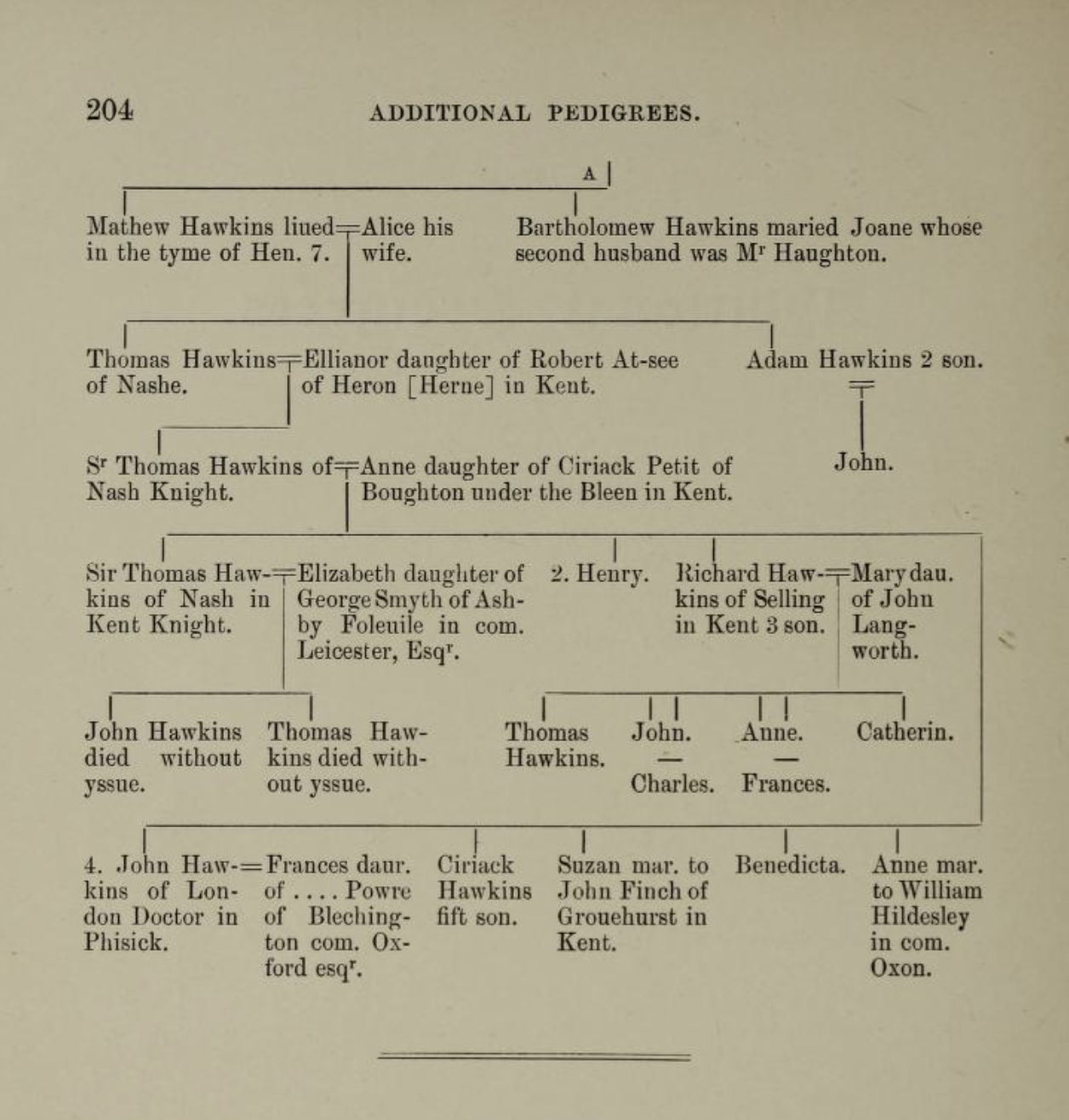
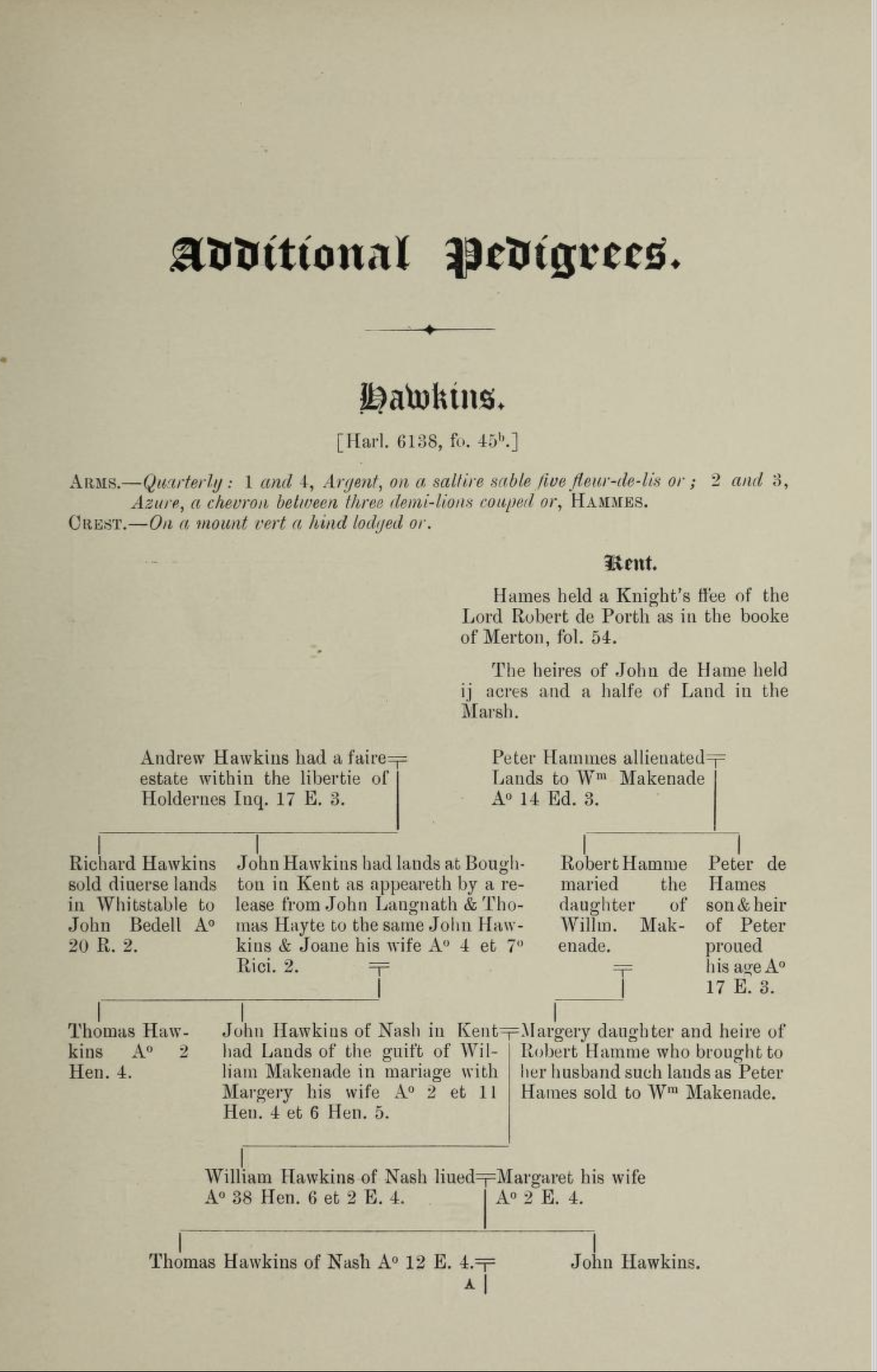
Additional Pedegrees. Hawkins. [Harl. 6138, fo. 45th.]
Sir Thomas Hawkins of Nash Knight
Wife: Anne daughter of Ciriack Petit of Boughton under the Bleen in Kent.
Son: Sir Thomas Hawkins of Nash in Kent Knight
Son: 2. Henry.
Son: Richard Hawkins of Selling Kent 3 son.
Son: John Hawkins of London Doctor in Phisick
Son: Ciriack Hawkins fifth son.
Daughter: Suzan mar. John Finch of Grouehurst in Kent.
Daughter: Benedicta.
Daughter: Anne. mar. to William Hildesley in com. Oxon.
!Source: Henry Hawkins and Partheneia Sacra https://www.jstor.org/stable/514283
In 1587-8 ‘Sir Thomas Hawkins of Nash Knight’ succeeded to the estate. He had married Anne, daughter of Cyriac Pettit from Boughton, in 1574 and had seven sons and six daughters, Hery being the second son. Two fine alabaster high-reliefs on the tomb of Sir Thomas [died 1617-18] and his wife [died 1616] in Boughton Church — major works by the sculpter Epiphanius Evasham — show the figures of thirteen children ‘grouped in an almost pictoral manner, some kneeling and som standing’….
!Source: thomas hawkins knight. https://forum.familyhistory.uk.com/threads/thomas-hawkins-knight.27164/
davelambert271 Loyal Member Location Leeds, born Hull From England
not what you asked for, but maybe useful
NASH is a mansion of account here, for having been the seat of the family of Hawkins, as is apparent, as well from records as from their own private evidences, for some centuries past, and where they still reside in their original gentility. The first of them that I find mention of, is Andrew Hawkins, who had a good estate in the liberty of Holderness, in Yorkshire, as appears by an inquisition taken anno 17 Edward III. and left by his wife >>> Joane de Nash, by whom he inherited this seat of Nash <<<, two sons, Richard and John, the latter of whom purchased lands in Boughton in the beginning of the reign of king Richard II. His son John Hawkins, esq. was of Nash, which continued in his descendants down to Thomas Hawkins, esq. of Nash, who dying in 1588, æt. 101, was buried with his wife in the north chancel of this church, under a tomb of Bethersden marble, on which is his figure in brass, and an inscription, which says he served king Henry VIII. which won him same, who was a gracious prince to him, and made well to spend his aged days; that he was high of stature, his body long and strong, excelling all that lived in his age. His only son >>> Sir Thomas Hawkins <<<, likewise resided at Nash, whose eldest son Sir Thomas Hawkins, of Nash, was a person of fine accomplishments and learning, and among other works translated Causinus's Holy Court, and died in 1640. In whose descendants resident at Nash, who lie all of them buried in the north chancel of this church, this seat at length continued down to Thomas Hawkins, esq. of Nash, who rebuilt this seat, of which he died possessed in 1766, æt. 92. In whose time, anno 1715, during the ferment the nation was thrown into on account of the rebellion in Scotland, this family being of the Roman Catholic persuasion, the seat of Nash was plundered by some of the neighburhood. Every part of the furniture, family pictures, writings of the estate and family, &c. were burnt by them, with an excellent library of books; and the family plate was carried off, and never heard of afterwards. Of his sons, John the eldest became his heir, and Edward-Thomas possessed the Gower estate, at Colmans, in Worcestershire, and took the name of Gower. John Hawkins, esq. the eldest son, on his father's death, became possessed of Nash, and married Susan, daughter of Robert Constantine, esq. of Dorsetshire, by whom he had two sons, to the eldest of whom, Thomas, he in his life-time gave up this seat, together with his other estates in this county. Thomas Hawkins, esq. married Mary, the daughter of John Bradshaw, esq. of London, descended from those of Stretton, in Cheshire, by whom he has four daughters. He resides at Nash, to which, with the grounds belonging to it, he has made great additions and improvements. The house is a large handsome building, pleasantly situated on the summit of the hill, having a fine prospect over the adjoining country, and has been sitted up within these few years with much taste in the modern stile. He bears for his arms, first and fourth, Hawkins, argent, on a saltire, sable, five fleurs de lis, or; second and third, Hames, azure, a chevron between three demi lions, rampant, or. 5 March 2015
!Source: Recusants and renegades ~ faith, family and resistance in early modern England https://recusantsandrenegades.wordpress.com/2014/11/18/calling-to-mynde-the-brittlenes-and-the-instabilitie-of-mans-lyfe-the-last-will-and-testament-of-sir-thomas-hawkins/
‘Calling to mynde the brittlenes and the instabilitie of mans lyfe’: the last will and testament of Sir Thomas Hawkins
Sir Thomas Hawkins of Nash Court, Boughton under Blean, Kent, died in April 1617. He was the father of a Jesuit priest, a Benedictine nun, a translator of recusant texts, and a physician, as well as being the father-in-law of Mary Langworth, whose family I have been attempting to trace over the past few weeks. Thomas Hawkins’ last will and testament, written in the month of his death, is a useful starting-point for exploring the illustrious Hawkins family. In this post, I’m reproducing my transcription of the will, and in the next post I’ll discuss what we can learn from it. I’ve kept to the original spelling and punctuation as far as possible. A question mark [?] indicates uncertainty about an individual word. Where words or passages are completely illegible, I’ve indicated this in parentheses. For ease of reading, key names are emboldened thus when first mentioned.
-